
AmazingAir 3500 in-depth review: UltraHEPA air purifier for work and home

Updated: Jun 1
Five years with the AmazingAir 3500 UltraHEPA air purifier (AirDoctor 3500 in the USA), filtering mould, pollen, dust and smoke. Reviewed by a nutritional therapist.

We spend up to 90% of our time indoors, which means the air inside our homes accounts for the vast majority of what we breathe. Yet indoor air carries far more than most people realise. I bought the AmazingAir (AirDoctor) 3500 in 2021 to address mould and endocrine disruptor exposure in my home. Five years on, I still run it daily, and it remains the air purifier I recommend most often through The Health Puzzle.
Table of contents
AmazingAir 3500 review at a glance
Best for: home, work or community spaces looking to reduce exposure to indoor air pollutants such as mould, pollen, dust and microplastics
Key feature: UltraHEPA filter capturing particles down to 0.003 microns, 100 times finer than standard HEPA
Coverage: up to 225m² (one air change per hour) down to 59m² (four air changes per hour).
Upfront cost: £549 RRP in the UK, or £439 with our AmazingAir and AirDoctor discount code
Running cost: approximately £26 per year on the lowest setting (running 24/7), or around £35 per year in typical auto mode use
Award: THP Gold Award, air purifier category
Five years in: still the air purifier we recommend most
What is the AmazingAir 3500?
The AmazingAir 3500 is a freestanding UltraHEPA air purifier. It’s the larger of two AmazingAir devices, capable of covering anything from a single bedroom to a community centre.
Air passes through three stages of filtration. A pre-filter catches the largest particles, a carbon and VOC filter handles gases and chemical compounds, and an UltraHEPA filter captures the finest particulates. There is also an optional ioniser, that can be switched on to support the filtration process.
There’s no professional installation required. The 3500 plugs into a standard power outlet, the filters slide into the front compartment, and the device is ready to use within minutes of opening the box.
What sets the AmazingAir 3500 apart?
There are a handful of air purifiers that filter to UltraHEPA standard, and a much larger number that filter only to standard HEPA. A few things make the 3500 stand out.
The headline feature is the UltraHEPA filter. It captures particles down to 0.003 microns, one hundred times finer than a standard HEPA filter, and it’s the main reason to choose this device over a cheaper air purifier. I explain exactly what that lets it filter, and why it matters, in the section on how the filtration works.
Beyond the filter, there are a few things worth knowing about how the device is built and tested.
It uses a fully sealed system. Air can’t bypass the filters through gaps in the housing, which is a problem with many cheaper air purifiers and reduces their real-world performance. With the 3500, the air that enters the device passes through every stage rather than leaking around the edges.
The fans are quiet. AmazingAir calls them WhisperJet fans, and in practice I’ve found the device noticeably quieter than I expected for its size on the lower settings, while still moving a high volume of air (a clean air delivery rate of 336 cubic metres per hour).
The device has been independently third-party tested, including against viruses, bacteria, and ultra fine particulates, with results the brand publishes for buyers to check directly.
Who makes AmazingAir?
AmazingAir is the UK and European arm of AirDoctor, the US brand that originally developed the UltraHEPA technology. AirDoctor is well-established in the United States, where awareness of indoor mould as a serious health issue is significantly more advanced than it is in the UK. In Europe, the same device is rebranded as AmazingAir and operates out of the Netherlands. The product itself is identical: the same filtration, the same dimensions, same engineering. Only the branding, pricing, plug type, and replacement filter sourcing differ by region.
AmazingAir is also a sister brand to AquaTru, the reverse osmosis water filtration company. Both share a similar approach with solid engineering and a focus on practical home use rather than gimmicks.
Why I purchased the AmazingAir 3500

I lived with chronic fatigue from around 2016 to 2022. In the early years, I made gradual progress through dietary changes, targeted supplements, and lifestyle adjustments. My energy lifted, my symptoms eased in places, but my health never quite landed where I wanted it to.
In 2021, while studying to become a nutritional therapist, I learned about a range of functional tests used in the field. I decided to make use of them. One of those tests was a urine test for mycotoxins, which revealed that my body was carrying high levels of Ochratoxin A, a mycotoxin produced by certain moulds and often associated with water-damaged buildings.
I tested my home and found mould in the loft, traced back to a roof leak and excess condensation. My bedroom sat directly below the loft hatch, which meant the air I was breathing in for hours each night was carrying mould compounds I did not know were there.
I couldn’t move out, so I started researching how to reduce my exposure. Through the work of Dr Jill Crista, author of Break the Mould, and conversations with other practitioners, I came across the AmazingAir 3500. From my research, I knew I needed an air purifier with:
A HEPA filter capable of capturing particles as small as 0.003 microns (most air purifiers filter to 0.3 microns, which is 100 times less precise)
Low running cost
Filters that were straightforward to change and not too expensive
Quiet enough to sleep beside
Multiple speed settings for different room sizes
The ability to be moved around the house easily
Simple setup with no installation required
The AmazingAir 3500 met every one of those criteria. It wasn't the cheapest option I looked at, the 3500 has an RRP of £549, though our discount code brings it to £439. Having worked through what was available, I decided the filtration and build quality were worth paying a little more for. Click here for our discount code
By 2022 my health had improved significantly, although I still need to be careful about burnout. Improving my indoor air quality wasn't the only change I made during that period. It was one of several factors, and one that mattered enough to me to still be running the device five years later.
AmazingAir 3500 review: design and features
Design and size
This device is designed around functionality before beauty. While it isn't terrible to look at, it is a big white plastic unit that sits at odds with a home looking to reduce their plastic usage. The plastic body keeps the weight down to 8.2kg, which makes it easy to move between rooms, and the form factor is unobtrusive enough that it fades into the background rather than dominating a space. A non-plastic version would feel more aligned with the kind of home it's most likely to live in, but that's a small wish rather than a complaint.
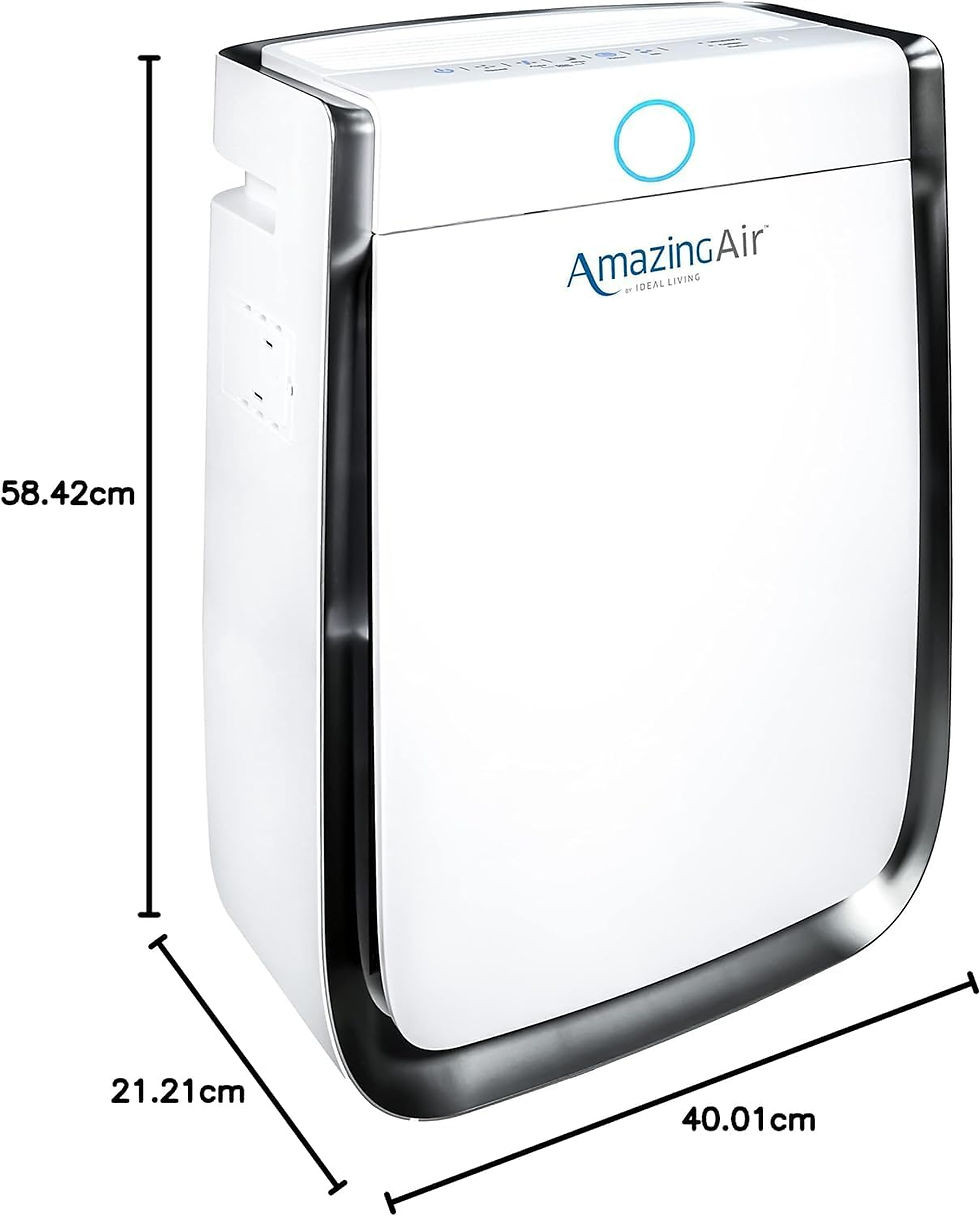
AmazingAir comes in two sizes, the 2000 and the 3500:
AmazingAir 2000: 47.55cm tall, 35.18cm wide, 16.8cm deep
AmazingAir 3500: 58.42cm tall, 40.01cm wide, 21.21cm deep
The 3500 covers up to 225m² with one air change per hour, 117m² with two changes per hour, and 59m² with four changes per hour. That coverage makes it suitable for whole-floor, multi-room use or single rooms which is why I chose the larger device.
The air filters through the front panel and is released through the top, which means the 3500 can sit flush against a wall as long as nothing (curtains, clothing) is close enough to be drawn into the filters and the top is clear. It’s been designed to sit on the floor, but mine has lived on an old drinks trolley for the past five years because of space limitations, and I’ve had no issues. If floor space is tight, this is a workable option.
Setting up and getting started
The 3500 arrived looking exactly as it had online, and setup took minutes. The filters slide into the front compartment, the front panel clips back into place, and you’re ready to plug in. There’s no installation, no app, no fuss.
When you press the power button on the top left, the light glows from red to blue, and the device defaults to auto mode. From here you can leave it running automatically or choose one of four speed settings manually.
Speed settings, auto mode and sensor

Speed 1 (low): quiet, suitable for working or sleeping. Great for ongoing filtration in one to two rooms.
Speed 2: my go-to for a 30-minute refresh in a single room. Ideal for ongoing filtration in three to four rooms.
Speed 3 and 4 (high): best for covering larger areas or quickly clearing the air after something has gone into it you’d rather not be breathing in
Over the years, I have preferred setting the speed manually rather than relying on auto mode. I keep the device on speed 1 while working or sleeping, where a sudden jump in fan noise would disrupt me. I move up to speed 2 for a quick room refresh, or when I’m doing something that throws dust, chemicals or fibres into the air, like cleaning, changing the bed or sewing. Speed 3 and 4 come out when I need to clear the air quickly or cover the whole top floor of the house.
Auto mode has its place if you plan to leave the device running full time and want it to adapt on its own. One thing worth knowing: the sensor only responds to larger particulate close to the device, so it will step up the speed when it detects dust but won’t react to nanoparticles, which are far harder to detect, especially at low levels.
Timer and night mode
There’s also a timer option, useful if you want the purifier running for an hour before bed without having to get up to switch it off, and a dim button that turns off the front and top lights for sleep.
Ioniser
The 3500 includes an optional ioniser. In simple terms, it releases negatively charged ions into the air that attach to airborne particles like dust and pollen, making them clump together and become heavier. This means they’re easier for the device to draw in and trap in the filter rather than settling on the surfaces around your room. The research on long-term exposure to ionisers is still developing, so I use this setting in short bursts when I’m out of the room rather than running it overnight while I sleep.
Noise
I’m particular about noise. I struggle to sleep or work with a ticking clock in the room, so one of my biggest concerns before buying the 3500 was whether it would be intrusive. On the lowest setting, it produces a soft white noise that’s easy to fall asleep to. In fact, when there’s a distracting sound (a snorer, building work outside, a neighbour’s dog), I’ll switch it on for the white noise effect alone.
At maximum speed, it’s roughly comparable to a washing machine, but I rarely use that setting for long stretches. One thing worth knowing: when you first turn the device on, it runs louder for a few seconds before settling to your chosen speed. This is fine during the day, but it puts me off switching it on at night if someone else is already asleep.
Weight and portability
At 8.2kg with a recessed handle on the back, the 3500 is solidly built. I’ll be honest though, at 5 foot 3 with a petite build I find it fairly heavy and a little awkward to move around. It is portable, and I do move it between rooms when I need to, but it’s not something I can move easily. My partner, who is taller and stronger, does not have any problems moving it from room to room.
Click here for our discount code
The filters: how they work, maintenance & costs
How the three-stage filtration works

Air passes through three stages on its way through the device, each doing a different job.
The pre-filter sits at the front and catches the largest particles: dust, hair, pet dander, and fibres. By trapping the big debris first, it protects the finer filters behind it, and it’s the one filter you clean rather than replace.
The carbon filter comes next. This is a single filter made of activated carbon, and its job is capturing gases and chemical fumes rather than particles: cooking odours, ozone, and the volatile organic compounds (VOCs) that off-gas from furniture, paint, cleaning products and soft furnishings. Gases like these are too small for any particle filter to catch, including UltraHEPA, so they need a filter built to absorb them rather than sieve them out. The carbon filter does also catch some particulates as air passes through it, but capturing gases and fumes is its proper job.
Then there’s the UltraHEPA filter, the stage that sets this device apart from a standard air purifier. A standard HEPA filter captures particles down to 0.3 microns, which already covers a lot, including dust, pollen, and whole mould spores. UltraHEPA goes one hundred times finer, down to 0.003 microns. Particles in the 0.003–0.3 micron range include:
Viruses: most fall between 0.02 and 0.3 microns (coronavirus around 0.1, influenza 0.08–0.12, rhinovirus 0.03)
Ultra fine combustion particles: diesel exhaust drifting indoors, cooking fumes, candle and incense smoke, wood smoke from log burners, wildfire smoke (often well below 0.1 microns)
Fine tobacco smoke
Nanoplastics: these range from about 0.001 to 1 micron, generated by plastic degradation, synthetic fabric abrasion, and tyre and road wear drifting indoors
Mould fragments: the tiny particulate that carries mycotoxins
It’s a big part of why I chose this device when I was dealing with mould in my home.
Cleaning and filter replacement
The pre-filter comes attached to the carbon filter, so a fresh one arrives with every carbon filter replacement. You can also buy a standalone pre-filter, and some people choose to swap it rather than clean it. I clean mine. Every four to six weeks I’ll hoover it gently, wipe it down with a lightly damp cloth, or use my hands to lift off the larger debris. It picks up a surprising amount of dust, hair and fibres, and I can usually get it looking close to new again. As long as I keep it clean, it stays effective for as long as the carbon filter lasts, with no filter-replacement warning light appearing. Keeping it clean is also what helps protect the more expensive filters sitting behind it. The carbon and UltraHEPA filters themselves shouldn’t be washed or vacuumed; only replaced when they reach the end of their life.
A note from my experience: the velcro fitted black mesh on the pre-filter looks like it should come off for a deeper clean, and technically it does, but the first time I tried this I stretched it slightly and it was harder to refit afterwards. I’d recommend cleaning it in place where possible.
To replace the main filters, switch off at the wall, unclip the hinged front panel, pull out the old filter, slot in the new one, close the panel, and you’re done.
Filter replacement: how long they last and what they cost
The device tracks filter life for you. When a filter is due for replacement, an indicator light comes on, so you don’t have to keep track yourself. In five years mine has been a reliable prompt rather than something I’ve had to second-guess.
The pre-filter should be cleaned every four to six weeks, and a fresh one comes attached to each new carbon filter. If you want to avoid cleaning the pre-filter, you can buy replacements separately. It is recommended that you replace the carbon filter every six months. And the UltraHEPA filter replaced roughly every twelve months.
How long your filters actually last depends on how heavily you use the device and what it’s filtering. Mine last longer than that guidance because I don’t run the device continuously. When I was using it more intensively, the timings were about right. Filter life is shorter in busier homes: pets, multiple occupants, high pollen and dust loads, regular crafting, and rooms with high-shedding materials like fluffy blankets will all bring replacement forward.
So what does that work out at? Here is what replacement filters currently cost. The device is the AmazingAir 3500 in the UK and Europe and the AirDoctor 3500 in the USA.
Replacement filter costs
Carbon filter (listed as the Carbon/Gas Trap/VOC filter): £65 / €65 / $63.95, replace roughly every 6 months
UltraHEPA filter: £75 / €75 / $63.95, replace roughly every 12 months
Standalone pre-filter: £20 / €20/ $20.95, optional, only if you’d rather replace it than clean it
1 Year Combo Pack: £175 / €175 / $162.99
2 Year Combo Pack: £330 / €330 / $305.89
Note: AirDoctor adds shipping (around $10 to $20) on top in the USA. AmazingAir also adds postage of around £5 on orders under £199.
In the UK and Europe that works out at roughly £140 to £175 a year, and in the USA roughly $130 to $165 a year plus shipping.
The combo packs are sold at a discount against the brand’s individual filter prices, with the greatest saving sitting with the two-year pack.
Energy costs
It's worth remembering the filters aren't the only ongoing cost. The device itself uses electricity, though not much. On its lowest setting it draws around 11 watts, which works out at roughly £26 a year if you ran it continuously. In typical use, mostly on low with occasional bursts higher, it's around £35 a year. At its highest setting it draws up to 95 watts, which would be roughly £225 a year if you somehow ran it flat out around the clock, but in practice almost nobody does; the high setting is for short bursts, not constant running. These figures are based on a UK electricity price of around 27p per kWh and will shift if energy prices change.
How I use the AmazingAir 3500 in real life
I currently work from my bedroom, which doubles as my home office. One 3500 covers both functions: I run it in the morning while I have breakfast so the air feels fresh when I come back to work. I run it again before bed, and I switch it on through the day whenever the air needs it. With a larger device in a smaller space, shorter bursts work well. When it’s been running for an hour, the difference is unmistakable. Walking back into the room is genuinely lovely. I take deeper breaths, similar to how I’d breathe at the seaside or in the woods.
When my partner and I move into our new house, my setup will look different. I’ll have a 2000 in each bedroom and home office (where doors stay closed) and a 3500 downstairs for the larger open-plan space. That said, if you can only afford one device, the 3500 is the more flexible choice. You can run it with the doors open and it will purify a whole upstairs or downstairs over a few hours. Beyond home use, the 3500 works well for offices, nurseries, schools, community centres, and any shared indoor space where multiple people spend long stretches of time.
Beyond the daily routine, there are a handful of specific moments where the 3500 earns its place again and again.
Pollen season
I get itchy eyes and sneeze on high-pollen days. When the count is high, I’ll give the air a boost on speed 2 for 30 minutes, then drop it to speed 1 for another hour. On milder days my symptoms ease completely. On heavily polluted days, the device reduces the worst of it, though showering pollen off your skin, hair, and eyelashes still matters when the count is high.
As someone who prefers to avoid medication where I can, this matters to me. I usually start taking hay fever tablets in early spring. This year we’re halfway through May and I haven’t taken one yet. On the few occasions I’ve felt the symptoms coming on, always in my bedroom, where the pollen drifts in through the open window, I’ve switched the purifier on instead. Within 30 minutes my symptoms had eased enough that I haven’t felt the need to reach for an antihistamine. That’s not a claim that the device replaces medication, just my positive experience this season.
Cleaning and sewing
Both kick up significant fibres and dust into the air. I run the device either on auto or speed 2 throughout the activity and for an hour or two afterwards.
The wood burner
Once a year we have our chimney swept and it would previously kick out lots of fine particulate that would take days to settle and could be found on surfaces all over the lounge. I now put the air purifier on the highest setting for a few hours after the clean; the difference is striking. Where ash and fine particles used to settle on every surface for several days afterwards, they’re cleared from the air within a few hours.
Sudden indoor air problems
There are many occasions that I look to quickly filter the air. For example, I recently tested out what was meant to be a natural room spray, only to find it was incredibly intense and gave me an instant headache. On the highest setting the room was bearable within a few minutes and clear within thirty. That kind of rapid response is genuinely reassuring to have on hand.
If you have severe airborne allergies or known poor indoor air quality, I’d recommend running the device continuously rather than in bursts. For most homes, switching it on and off as needed, with the timer for sleep, works well.
Click here for our AmazingAir and AirDoctor discount code
Why indoor air quality matters: general background

This section is general background on indoor air quality. It isn’t a claim about what this specific device does or what it can do for your health. It’s here because understanding the problem is what helped me make sense of the solution, and it may help you too.
We spend up to 90% of our time indoors, which means the air inside our homes makes up the vast majority of what we breathe. We tend to think of air pollution as something outdoors: traffic, industry, smog. But indoor air is often more polluted than the air outside, and we’re exposed to it for far longer.
Indoor air carries a mix of things most of us never think about. Dust and dust mites. Mould spores and the finer fragments mould breaks down into. Pollen that drifts in through windows and on clothing. Pet dander. Combustion particles from cooking, gas hobs, candles, wood burners and traffic outside. And a wide range of gases and chemical compounds: the volatile organic compounds (VOCs) that off-gas from new furniture, paint, flooring, mattresses, cleaning products, and air fresheners.
The research increasingly points to indoor air quality as something worth taking seriously. Poor indoor air has been associated in studies with a range of effects, from short-term irritation of the eyes, nose and throat, to headaches and tiredness, through to longer-term concerns with prolonged exposure. Some indoor pollutants, like the ultra fine particles from combustion and the compounds released by certain moulds, are of particular interest to researchers because of how small they are and how deep into the body they can travel.
This isn’t meant to alarm anyone. Every home has indoor air pollution; it’s a normal part of modern living. But it is one of the more overlooked parts of a healthy home, partly because you usually can’t see it, and partly because awareness of it in the UK lags behind countries like the United States, where indoor mould in particular is taken more seriously.
This is also where it’s worth being clear about priorities. The most effective thing you can do for your indoor air isn’t to filter it, it’s to stop polluting it in the first place. Improving ventilation, tackling damp and humidity at the source, and choosing low-VOC furniture, paint and cleaning products will always do more than any device, because they reduce the problem rather than manage it. That order matters, and it sits at the heart of how we approach health at The Health Puzzle: prevention first, then support what’s left. An air purifier belongs in that second category. It doesn’t replace the basics, it works alongside them, capturing what’s still in the air after you’ve reduced what you can.
What I’d change
No device is perfect, and after five years I’ve got a clear sense of the things I’d change if I could.
The most obvious one is the plastic. It’s a slight irony that a device designed to reduce airborne particles, including the fine plastic particles modern homes shed, is itself made largely of plastic. I understand why: it keeps the weight down and makes it more durable and affordable than metal would. But for a product most likely to live in the home of someone actively trying to reduce their plastic exposure, a lower-plastic version would feel more aligned with the buyer it attracts.
The second is the startup noise. Whatever speed you select, the device briefly runs louder for the first few seconds before settling. During the day, this isn’t a problem. At night, if someone is already asleep in the room, that initial burst is enough to put me off switching it on.
The third is that there is a small learning curve. It took me a little while to get confident with the speed settings, the auto mode’s limits, and how best to clean the pre-filter without damaging it. Nothing major, just something I struggled with.
None of these would stop me from buying it again. They’re the honest minor frustrations of living with the device for five years, not deal breakers.
Who the AmazingAir 3500 isn’t right for
I recommend the 3500, but it doesn’t suit everyone.
If you only need to filter one small room, it may be more device than you need. The smaller AmazingAir 2000 has the same filtration technology in a lower-priced, smaller unit, and our discount code applies to it too. My partner uses a 2000 in his home office and it’s well suited to a single room. And if the 3500 is a stretch, the 2000 is the more affordable way into the same filtration technology, rather than dropping to a cheaper purifier that won't filter as fine.
Warranty and longevity
The AmazingAir 3500 comes with a two-year manufacturer’s warranty covering technical defects and faults under normal use. Unopened, unused units can be returned within 14 days.
A two-year warranty is fairly standard for this kind of device, neither generous nor stingy. What matters more to me is what happens after the warranty ends, and that’s where five years of daily use is genuinely useful to report.
Mine has not faltered. Nothing has broken, the fan still runs as it did on day one, and it has needed no repairs or servicing in five years. The only visible sign of age is slight yellowing of the white plastic, which I genuinely didn’t notice until I compared it side by side with a newer unit. It has no effect on how the device works; it’s purely cosmetic.
For a device that runs daily, often overnight, that’s a reassuring track record. It’s worth saying I can only speak for my own unit, and no single example proves long-term reliability across the board. But five years of trouble-free use is the kind of thing I’d want to know before spending this much, so it’s worth putting on record.
AmazingAir 3500 review FAQs
Is the AmazingAir 3500 the same as the AirDoctor 3500?
Yes. It’s the same device, made by the same company. AirDoctor is the US brand; AmazingAir is the UK and European brand. The filtration, dimensions, and engineering are identical. Only the branding, pricing, plug type, and where you buy replacement filters differ by region.
What does the AmazingAir 3500 filter out?
It uses three stages: a pre-filter for large particles like dust and hair, a carbon filter for gases, odours, and VOCs, and an UltraHEPA filter that captures particles down to 0.003 microns, a hundred times finer than standard HEPA. That ultra fine stage lets it catch fine mould fragments, the particulates that carry mycotoxins, many viruses and the fine combustion particles from cooking, traffic and wood smoke.
How much does it cost to run?
The electricity is modest: roughly £26 a year on the lowest setting if run continuously, around £35 a year in typical use. The more meaningful ongoing cost is the replacement filters, roughly £140 to £175 a year depending on how heavily you use it.
How often do the filters need replacing?
The carbon filter is replaced roughly every six months and the UltraHEPA filter roughly every twelve, though both last longer with lighter use. The pre-filter is cleaned rather than replaced. A filter-replacement indicator light tells you when it’s due.
Is it noisy?
On the lowest setting, it produces a soft white noise that’s easy to sleep through, quiet enough that I run it overnight. It’s louder on the higher settings, comparable to a washing machine at maximum, but those are for short bursts. The one quirk is a brief, louder burst for the first few seconds at startup.
Is the AmazingAir 3500 worth it?
For a single small room, the cheaper AmazingAir 2000 or a standard-HEPA purifier may be enough. But if you’re dealing with mould, allergies, pets or smoke, or you want the strongest filtration you can reasonably get for a home or shared space, the ultra fine filtration and five years of trouble-free use have, in my experience, made it worth the price.
Where's the best place to buy the AmazingAir 3500, and is there a discount?
Buy directly from AmazingAir (UK and Europe) or AirDoctor (USA) rather than third-party sellers, so you're covered by the manufacturer warranty and getting genuine filters. We have an exclusive discount code for our readers.
AmazingAir and AirDoctor discount codes
We have an exclusive discount code for readers of The Health Puzzle helping you to save money on all AmazingAir and AirDoctor air purifiers:
UK and Europe: see our AmazingAir discount code post for the current code and how to use it.
USA: see our AirDoctor discount code post for the current code and how to use it.
Buying direct through either brand also means you’re covered by the manufacturer warranty and getting genuine filters, which matters with a device you’ll be running daily for years.
Final thoughts after five years
Five years is long enough to know a device properly. The early enthusiasm has worn off, the novelty has gone, and what’s left is simply whether it still earns its place. The AmazingAir 3500 does.
It hasn’t faltered. It still runs as it did on day one, the filtration still does what it’s meant to, and the only sign of age is a bit of yellowed plastic I had to look for. For something that runs in my bedroom most nights and through much of my working day, that’s the track record I’d have wanted to know about before buying.
It isn’t perfect, and I’ve tried to be honest about that. It’s a large plastic unit in a home I’d rather keep low-plastic. It’s heavy to move if you’re not tall or strong. The startup noise is a minor irritation at night. And it isn’t the cheapest option, upfront or in filters. None of that has changed my view that, for what it does, it’s worth it.
What it comes down to is this: most of what we breathe is determined by our indoor environment, and for years I did not know how much that was affecting me. Sorting out the mould, ventilating better, and reducing what I was putting into the air all mattered. The AmazingAir 3500 is the device that handles what’s left, the fine particles I can’t see and can’t fully prevent. It’s the one I chose when I was dealing with mould, the one I’ve relied on every day since, and the one we’re confident giving our THP Gold Award.
If you’re weighing it up, I hope five years of honest use has helped you decide whether it’s right for you.
This review contains affiliate links. If you buy through them, The Health Puzzle may earn a small commission at no extra cost to you. It does not change the price you pay, and it has not influenced the contents of this review. I bought my AmazingAir 3500 myself in 2021 and have used it daily for five years. The views here are my own, honest account, including the things I'd change. We only recommend products we genuinely rate. You can read more in our affiliate policy.


Comments